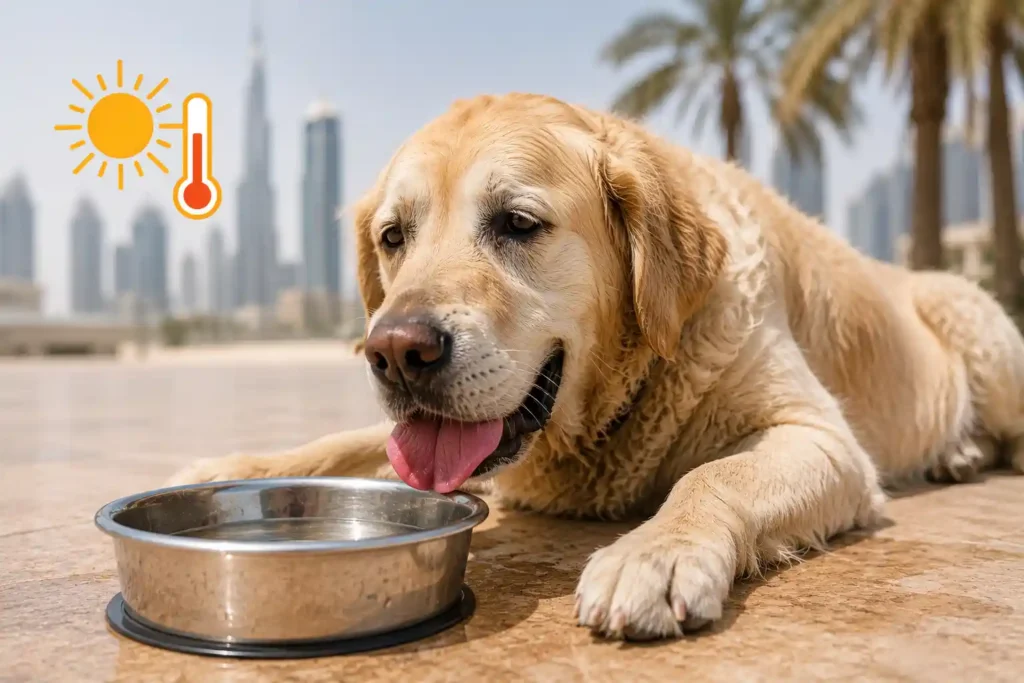
Last July, a young Labrador named Bruno came in barely able to lift his head. His owner had taken him for their usual afternoon walk — the same route they’d done all winter — but this time the pavement was radiating heat and Bruno had gone quiet halfway home. By the time they reached us, his gums were tacky and his eyes looked sunken. Bruno recovered well, but his case is one we see every summer, and almost always it traces back to the same thing: a dog quietly slipping into dehydration while everything looked normal.
Dogs can’t tell us they’re thirsty, and in the UAE’s punishing summer that gap between “seems fine” and “in trouble” can close fast. Knowing what to look for is one of the most useful skills a pet owner here can have — and if you’re ever unsure, a quick call to your vet clinic in Sharjah is always safer than waiting it out. Here’s how to read the signs early.
Why UAE summers make dehydration in dogs so dangerous
Dogs don’t cool themselves the way we do. They have very few sweat glands and rely almost entirely on panting to shed heat — a system that works reasonably well at 25°C and starts failing badly when the air itself is 45°C or hotter. When the surrounding temperature climbs close to a dog’s own body temperature, panting simply can’t move enough heat, and fluid loss accelerates.
Add the local realities and the risk multiplies. Sun-baked asphalt and sand can sit far hotter than the air, radiating heat up at a dog whose body is only inches off the ground. Humid coastal evenings make panting even less effective. And a bowl of water left out can turn unpleasantly warm within an hour. In this environment, dehydration in dogs isn’t an occasional worry — it’s a daily one from May through September.
The signs of dehydration in dogs
Dehydration exists on a scale, and the early signals are subtle. Catching them at the “mild” stage is what keeps a dog out of the emergency category.
Early and mild symptoms include tacky or sticky gums, thick ropy saliva, a dry nose, mild lethargy or reluctance to move, and reduced appetite. Excessive panting that doesn’t settle with rest is another early flag. On their own these can be easy to dismiss, which is exactly why they’re worth taking seriously in hot weather.
Two quick home checks help you assess hydration in seconds:
The skin-tent test. Gently lift the loose skin between your dog’s shoulder blades or at the scruff, then let go. In a well-hydrated dog it snaps back instantly. If it settles slowly or stays “tented” in a ridge for a moment, that points to fluid loss. One caution: this test isn’t perfect. Overweight dogs can spring back normally even when dehydrated, while thin, older, or loose-skinned dogs may tent slightly when perfectly healthy — so learn what’s normal for your dog when he’s well.
The gum and capillary-refill test. Healthy gums are wet and slippery. Dehydrated gums feel dry, sticky, or tacky. Next, press a finger gently on the gum until it blanches white, lift off, and watch the pink return. Under two seconds is normal; a slower refill suggests dehydration or poor circulation. (If your dog has black-pigmented gums, find an unpigmented patch to read.)
Moderate to severe symptoms of dehydration in dogs are more obvious and more urgent: clearly sunken or dull eyes, marked lethargy, weakness or wobbliness, dark and reduced urine, a racing heartbeat, cool-feeling limbs, disorientation, and in the worst cases collapse. These are not “watch and wait” signs.
When dehydration becomes an emergency
Here’s the connection every UAE owner needs to make: in summer, dehydration and heatstroke travel together. A dog that is overheating is losing fluid fast, and a dehydrated dog cools itself even less effectively — a dangerous loop. Warning signs that a situation has tipped into a true emergency include relentless heavy panting, bright red or very pale gums, vomiting or diarrhoea, stumbling or confusion, and collapse.
If you see these, act immediately — move your dog into air conditioning or shade, offer small amounts of cool (not ice-cold) water, and wet the paws, belly, and ears with cool water while you get veterinary help. For dogs who are already weak, elderly, brachycephalic (flat-faced breeds like Pugs and Bulldogs), or too fragile to travel safely in the heat, our mobile vet in Sharjah service can bring urgent assessment and fluid support to your door rather than risking a hot car journey.
What to do if your dog is dehydrated
For mild cases where your dog is still alert and drinking, you can often stabilise things at home while you arrange a check-up:
Do offer fresh, cool water in small, frequent amounts rather than letting a parched dog gulp a whole bowl at once. Do move them somewhere cool and let them rest. Do ask your vet before offering any electrolyte solution, and mention any vomiting, diarrhoea, or refusal to drink, since those change the picture. Don’t force water into the mouth of a weak or collapsing dog — it can be inhaled. Don’t use ice-cold water or ice baths in a heatstroke situation, as cooling too aggressively causes its own problems. And don’t assume a dog that “perked up” is fully recovered; moderate dehydration can take a day or two and sometimes intravenous fluids to correct properly.
Responding promptly isn’t only good care — it reflects a wider duty. Under the animal-welfare framework overseen by the UAE Ministry of Climate Change and Environment, protecting pets from harmful conditions and providing appropriate veterinary treatment is a recognised responsibility of every owner. In a Gulf summer, that responsibility is very real.
Preventing dehydration in dogs this summer
Prevention is far easier than treatment. Walk only in the early morning or after dark, and use the five-second rule — if you can’t hold your palm flat on the pavement for five seconds, it’s too hot for paws and too hot for the walk. Keep multiple bowls of fresh water around the home and refresh them often. Ensure your dog always has access to a cool, air-conditioned space, never a balcony or shaded-but-hot outdoor area. Never leave a dog in a parked car, even for a minute — interiors reach lethal temperatures shockingly fast. And build in routine check-ups so any underlying condition that worsens fluid loss is caught early; if you’re still choosing where to go, our guide to finding the best veterinary clinic in Sharjah can help.
The bottom line
The signs of dehydration in dogs — tacky gums, a slow skin-tent, sunken eyes, lethargy, dark urine — are quiet at first and loud once it’s serious. In the UAE, where the heat does half the damage before you notice, the winning move is to check early and act fast. Bruno the Labrador is thriving today because his family learned to read those signals. With a little vigilance, cool water always within reach, and walks kept to the cool hours, your dog can get through the hottest months safely too.
Frequently Asked Questions
What are the first signs of dehydration in dogs?
The earliest symptoms are usually tacky or sticky gums, thick saliva, a dry nose, mild lethargy, reduced appetite, and panting that doesn’t settle with rest.
How do I check if my dog is dehydrated at home?
Use the skin-tent test (lift the scruff — it should snap back instantly) and check the gums (they should be wet, with pink colour returning under two seconds after you press them). Slow results suggest dehydration.
How much water should a dog drink in summer?
Many dogs need roughly 50–60 ml per kg of body weight daily, with more during heat and exercise. Always keep fresh, cool water available and monitor that your dog is actually drinking.
Is dehydration in dogs an emergency?
Mild cases can often be managed at home with cool water and rest, but sunken eyes, weakness, dark urine, collapse, or signs of heatstroke require immediate veterinary care.
Which dogs are most at risk in UAE summers?
Flat-faced breeds (Pugs, Bulldogs), puppies, senior dogs, overweight dogs, and those with heart or breathing conditions dehydrate and overheat faster and need extra caution.