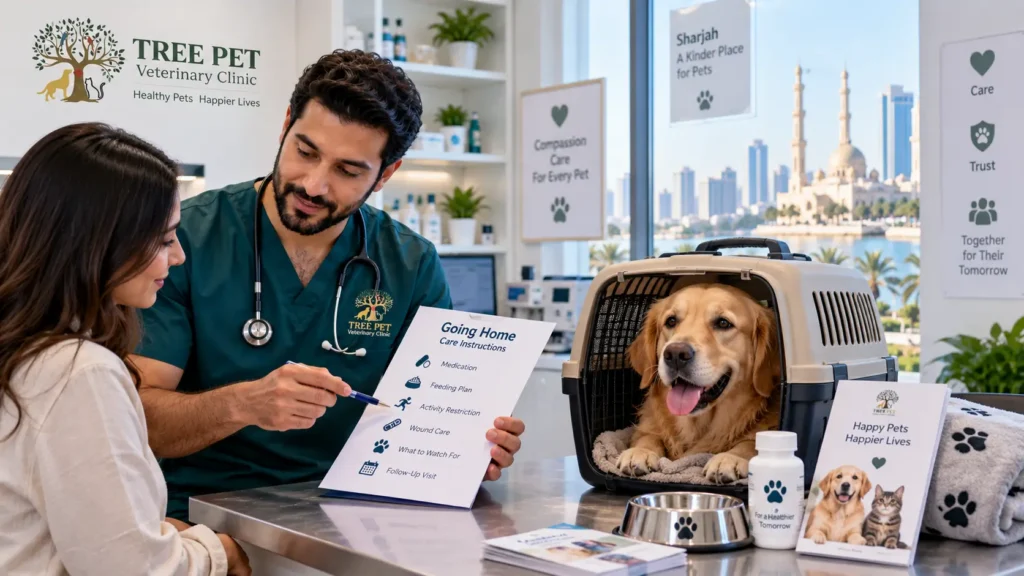
She had been asking questions throughout the entire consultation, the kind that tell me an owner has been paying close attention. But only when I handed over the discharge notes and said, “You can take Biscuit home now,” did the question she really needed to ask finally come out.
“How will I know if he’s recovering properly?”
Biscuit was a four-year-old Shih Tzu who had been treated for a gastrointestinal issue that had left him lethargic and off his food for several days. The treatment had gone well. He was stable, brighter than when he arrived, and ready to leave. But his owner understood something that not every pet owner immediately recognizes: walking out of a veterinary clinic in Sharjah does not mean the care has ended. It means the next stage of it is beginning somewhere else.
Going Home Doesn’t Mean the Care Is Over
Pet recovery after treatment rarely happens entirely within the walls of a clinic. For many conditions, the most important phase of recovery unfolds at home, where the pet is most comfortable, where their normal behaviour is most visible, and where the owner’s observations become a genuine part of the ongoing care process.
Depending on the condition and treatment, a pet returning home may still need prescribed medication, dietary adjustments, activity restrictions, wound care, or simply careful observation over the days that follow. Not every pet requires intensive aftercare. Some will need very little beyond rest and a quiet environment. Others will need more structured support. What is appropriate depends on what the pet has been treated for and how the treatment was delivered.
What Should You Watch for at Home?
I often tell owners that they are not expected to become medical professionals overnight. What I am asking for is something they already do naturally, paying attention to their pet.
In the days following treatment, the things worth watching include appetite, water intake, energy levels, behaviour, comfort, movement, and toileting habits. For pets that have had a procedure or wound care, the treated area should be checked as directed. Owners should also observe how the pet is responding to any prescribed medication, whether they are tolerating it well and whether any changes in their condition are becoming apparent.
The specific things to monitor will depend on the individual situation and the instructions provided at discharge. If something does not seem right, or if the pet’s condition is noticeably different from what was described as expected, that observation is worth sharing with the veterinary team.
Recovery Doesn’t Look the Same for Every Pet
A young dog recovering from a minor procedure is in a very different situation from an older cat managing a chronic condition alongside a recent treatment. Age, overall health, the nature of the condition, the type of treatment received, and the individual animal’s resilience all shape what recovery looks like.
I avoid giving owners a fixed timeline for recovery because doing so can create false expectations in both directions. A pet that takes longer than anticipated is not necessarily failing to recover. A pet that bounces back quickly may still need to complete their prescribed treatment course fully. Recovery is a process, not a date on a calendar, and it is rarely identical from one patient to the next.
Following the Treatment Instructions Matters
The instructions provided at discharge are not suggestions; they are part of the treatment itself, continuing outside the clinic.
Giving prescribed medication exactly as directed, at the correct times and for the full recommended duration, is one of the most important things an owner can do. Stopping early because a pet appears to have improved is one of the most common reasons conditions return or become more difficult to manage. Dietary instructions, activity restrictions, and wound care guidance exist for equally specific clinical reasons.
If any instruction is unclear, the right response is to contact the veterinary team and ask rather than making an assumption and continuing regardless. A brief call to clarify is always worth making.
When Should You Contact the Vet?
Knowing when to call is just as important as knowing what to do at home. Owners should contact their veterinarian promptly if they notice worsening discomfort, repeated vomiting, significant loss of appetite that was not expected, increasing lethargy, unusual swelling, concerning changes around a wound or treated area, or any sudden deterioration in the pet’s condition. Difficulty breathing or difficulty urinating should always be treated as urgent and assessed without delay.
Not every unexpected observation requires an emergency visit, but none of them should be silently dismissed either. When something does not feel right, that instinct is worth acting on.
Why Follow-Up Appointments Still Matter
A follow-up appointment is not the veterinarian checking that the owner followed instructions. It is an opportunity to gather clinical information that was not available at the time of the original visit.
By the time a follow-up takes place, the pet’s response to treatment has developed, healing has progressed, or new questions have arisen, and any changes noticed at home can be discussed in context. Understanding how follow-up fits into the diagnostic process helps explain why these appointments carry genuine clinical value; they allow the veterinarian to assess whether the plan is working, whether anything needs to be adjusted, and whether further care is indicated.
Sutures may need to be removed. Repeat testing may be appropriate. Medication may need to be reviewed. Activity restrictions may be able to be reduced. None of these decisions can be made responsibly without seeing the patient again.
What If Recovery Isn’t Going According to Plan?
Recovery does not always proceed in a straight line, and it is important that owners feel comfortable reaching out when something seems unexpected.
A pet may improve more slowly than anticipated, develop a new symptom, respond differently to medication, or simply not return to their normal self as quickly as hoped. When this happens, it does not automatically mean the treatment was wrong or that something has gone seriously wrong. It means the veterinarian needs to reassess to look at where the pet is now, consider what has changed, and decide whether any adjustment to the plan is appropriate.
Veterinary care does not end with a prescription or a procedure. It is an ongoing process of observation, reassessment, and refinement when necessary.
Frequently Asked Questions
How long does it take for a pet to recover after treatment?
Recovery timelines vary considerably depending on the condition, the type of treatment, the pet’s age, and their overall health. There is no single answer that applies to every pet or every situation. The veterinarian will provide guidance on what to expect for your pet’s specific circumstances, and follow-up appointments allow that progress to be assessed properly.
What should I monitor when my pet comes home?
Watch for changes in appetite, water intake, energy levels, behaviour, comfort, movement, and toileting. If a wound or treated area is involved, monitor it as directed. The most useful thing an owner can do is pay attention to anything that feels noticeably different from what the veterinarian described as expected.
When should I call the vet after treatment?
Contact your veterinarian if you notice worsening discomfort, repeated vomiting, significant or unexpected loss of appetite, increasing lethargy, swelling, or changes around a treated area. Difficulty breathing or urinating should be treated as urgent. When in doubt, a call to the clinic is always the right move.
Does my pet always need a follow-up appointment?
Not always — but when one is recommended, it serves a genuine clinical purpose. Follow-up allows the veterinarian to assess healing, evaluate the response to treatment, review any changes noticed at home, and decide whether further care is needed. It is part of the care plan, not an optional addition.
What should I do if my pet isn’t recovering as expected?
Contact your veterinarian rather than waiting to see if things improve on their own. Slower recovery, new symptoms, or unexpected changes are all worth discussing. The veterinarian may need to reassess the pet and consider whether any adjustment to the treatment or recovery plan is appropriate.
Going Home Is Not the End of Treatment
When Biscuit’s owner asked how she would know if he was recovering properly, my answer was the same one I give to every owner in that moment: you will know better than anyone, because you know what normal looks like for him.
The clinic provides the treatment. The diagnosis gives the direction. But pet recovery- the actual, day-by-day process of returning to health happens at home, with the owner as its closest observer. Following the discharge instructions, watching for the changes that matter, attending the follow-up when it is recommended, and reaching out when something does not seem right are not small contributions. They are the continuation of care.
If your pet has recently completed treatment or is preparing to go home after a procedure, our team is here to make sure you leave with a clear understanding of what comes next and the confidence to manage recovery well.