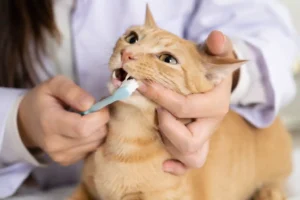
A few months ago, a client carried in a five-year-old Persian named Simba, worried only about a “runny eye.” Simba was eating, purring, and looked perfectly healthy. But when I gently lifted his lip, the story his mouth told was very different: inflamed gums, a thick brown crust of tartar, and a small pink lesion eroding one of his back teeth. His owner was stunned. “He never showed any pain,” she said. That single sentence explains why feline dental disease is so dangerous — and why this blog exists.
As a veterinary clinic in Sharjah, we regularly see cats with advanced dental disease that went unnoticed because they showed no obvious signs of pain. Early dental care and routine veterinary examinations are the best way to protect your cat’s oral and overall health.
Quick answer: how often should you brush your cat’s teeth?
Ideally, brush your cat’s teeth once a day. Daily brushing is the gold standard because plaque begins forming within hours of a clean, and it is the only reliable way to interrupt that cycle at home. If daily brushing isn’t realistic for your household, aim for a minimum of three times per week — that is the lowest frequency most veterinarians consider genuinely effective at slowing dental disease.
That’s the short version. The rest of this article explains why the timing matters and how to recognise the moment your cat has quietly moved past what a toothbrush can fix.
Why daily matters: the 24-hour plaque window
Here’s a detail most cat owners never hear. When plaque — the soft, sticky film of bacteria — sits undisturbed on a tooth, it starts to harden and mineralise into tartar in a matter of days, sometimes within 24 to 72 hours. Once plaque becomes tartar, no brush, dental treat, or water additive can remove it. It has to be scaled off professionally under anaesthesia.
So brushing isn’t really about “cleaning” in the way we think of it for ourselves. It’s about resetting the clock before soft plaque gets the chance to turn into cement. Brush inside that window and you win. Miss it repeatedly and the problem compounds, tooth by tooth.
A useful trick: cats have famously rough tongues, and that natural sandpaper tends to keep the inner surfaces of the teeth reasonably clean on its own. Damage builds up on the outer surfaces facing the cheek — so those are the ones your brush should focus on. You don’t need a perfect, all-around scrub. A few honest seconds along the outer gum line does most of the work.
The condition that shocks most cat owners
Periodontal (gum) disease is common — depending on the study, somewhere between 50% and 90% of cats over the age of four show some degree of it. But there’s a second, quieter problem that is almost unique to cats: tooth resorption.
In tooth resorption, the cat’s own cells begin dissolving the tooth from the inside out. It is the single most common cause of tooth loss in cats, and estimates suggest it affects anywhere from 20% to 60% of all cats, rising to roughly three-quarters of cats over five years old. Here is the part I always make sure clients understand: the cause is still unknown, and unlike gum disease, brushing does not prevent it. That’s precisely why home care and professional exams are partners, not substitutes. A toothbrush protects the gums; only a veterinary exam — often with dental X-rays — can catch resorption early, when it’s still hidden below the gum line.
Simba, from the start of this story, had both problems at once. His gum disease was preventable. His resorption was not — but catching it during a routine visit meant we could relieve his pain before he stopped eating.
Signs your cat needs dental care
Cats descend from solitary hunters, and hiding weakness is wired deep into their instincts. A cat with a painful mouth will very often keep eating and keep purring right up until the disease is advanced. So instead of waiting for obvious distress, watch for these subtler signals:
- Bad breath. Persistent foul odour is not “just cat breath.” It’s usually the first sign of bacterial overgrowth.
- Yellow or brown buildup along the gum line, especially on the back teeth.
- Red, swollen, or bleeding gums, or a visible pink defect where a tooth meets the gum.
- Changes in how they eat — chewing on one side, dropping kibble, swallowing food whole, or suddenly preferring soft food.
- Drooling, pawing at the mouth, or “chattering” of the jaw.
- Behaviour shifts — a normally social cat hiding, becoming irritable, or grooming less.
If you notice even one of these, it’s worth a professional look. For a broader checklist that applies to dogs too, our team put together a helpful guide on the signs your pet needs a dental cleaning.
How to actually brush a cat’s teeth (without the battle)
Most owners give up not because the cat refuses forever, but because they start too fast. Slow is the whole secret.
- Start with taste, not tools. For the first few days, let your cat lick a little pet-specific toothpaste off your finger so it becomes a treat, not a threat.
- Introduce touch. Gently lift the lip and rub a finger along the outer gums for a few seconds. Reward immediately.
- Add the brush. Move to a soft cat toothbrush or finger brush, holding the head at a slight angle and focusing on the outer surfaces of the cheek teeth and canines.
- Keep it short and positive. Ten to fifteen seconds is a real success. End on a good note, every time.
One firm rule: never use human toothpaste. It contains fluoride and, in many cases, xylitol and foaming agents that are toxic to cats, who swallow everything you put in their mouth. Always use a product made for cats — and look for the Veterinary Oral Health Council (VOHC) seal, which flags products actually proven to reduce plaque or tartar.
Kittens learn fastest, so starting young is ideal, but I’ve trained plenty of grumpy adult cats too. It just takes patience.
Home brushing isn’t enough on its own
Even with perfect daily brushing, your cat still needs a professional dental check. Surveys suggest only a small fraction of cats — under 10% — ever receive dental care at a vet, which is a big reason feline dental disease is so widespread and so under-diagnosed. Brushing manages plaque above the gum line; it can’t reveal what’s happening at the roots, where resorption and bone loss begin.
Left untreated, oral bacteria don’t just stay in the mouth. They can enter the bloodstream and place strain on the heart, liver, and kidneys — turning a “dental” problem into a whole-body one.
That’s why I recommend pairing home brushing with an annual oral exam as part of a routine wellness check-up, plus a professional cleaning whenever your vet advises one. You can learn more about scaling, polishing, X-rays, and extractions on our pet dental care in sharjah page.
The bottom line
Brush daily if you can, three times a week at the very least, always with cat-safe toothpaste, and always with an eye on the outer teeth. Then let your veterinarian handle what a brush can’t reach. Simba is doing wonderfully today — pain-free and eating like a champion — because his family paired good home care with a professional exam that caught what they couldn’t see. Your cat’s mouth may be telling a quiet story too. The sooner you listen, the happier that story ends.
Frequently Asked Questions
How often should I brush my cat’s teeth?
Daily is ideal. If that isn’t possible, brush at least three times a week using toothpaste made specifically for cats.
Can I use human toothpaste on my cat?
No. Human toothpaste can contain fluoride and xylitol, which are toxic to cats. Use a pet-specific toothpaste only.
At what age should I start brushing my cat’s teeth?
As early as kittenhood — around two months old — since young cats adapt fastest. Adult cats can still learn with gradual, patient training.
Does brushing prevent all cat dental problems?
Brushing effectively prevents gum (periodontal) disease, but it cannot prevent tooth resorption, whose cause is unknown. That’s why regular veterinary dental exams remain essential.
How do I know if my cat needs professional dental care?
Watch for bad breath, brown tartar, red or bleeding gums, drooling, dropping food, or eating on one side. If you notice any of these, book a veterinary dental exam.